This is a law of physics called the second law of. This law has more to do with modern refrigerators because it defines that it is possible to raise the temperature of a system either by adding heat (thermal energy) or by doing work on it.

Refrigeration Cycle Thermodynamics Second Law Of Thermodynamics Reversible Process
For food preservation or air conditioning), and the basic apparatus is a refrigerator, a thermal machine producing cold.

How does a refrigerator work thermodynamics. Thermodynamics second law can help us better understand how the basic refrigeration cycle works. The refrigerant gas condenses into liquid at high pressure. There is the following problem in a textbook on thermodynamics:
As we've just seen, a refrigerator works by sucking up heat from the chiller cabinet with a cooling fluid, then pumping the fluid outside the cabinet, where it releases its heat. A refrigerator causes heat to flow from cold to hot by inputting work, which cools the space inside the refrigerator. The evaporation valves are present inside the fridge thus when the cold liquid enters these valves, the warmness present in the refrigerator will be absorbed by the cold liquid.
Typically the thermodynamic system in a refrigerator analysis will be a working fluid, a refrigerant, that circulates around a loop, as shown in figure 3.7. According to the second law of thermodynamics, heat will always flow spontaneously from hot to cold, and never the other way around. The second law of thermodynamics essentially states that if a cold object is placed next to a hot object, the cold object will become warmer and the hot object will.
The freezer is surrounded by the evaporator tube. The second law of thermodynamics states that if a cold object is placed next to a hot object, the cold object will become warmer and the hot object will become cooler. The compressed gas heats up as it is pressurized.
As can be seen, the better (more efficient) the refrigerator is when more heat q cold can be removed from the inside of the refrigerator for a given amount of work. The other principle at work in a refrigerator is that when you have two things that are different temperatures that touch or are near each other, the hotter surface cools and the colder surface warms up. The curve is the saturation curve.
Refrigerators work because of physics. January 8, 2015 refrigeration admin. How does a refrigerator work?
For an ideal refrigerator (without losses and irreversibilities) can be derived that:. The second law of thermodynamics is considered to be the most fundamental law of science. How does a refrigerator obey the 2nd law of thermodynamics?
A refrigerator is a device which maintains a body at a temperature lower than the temperature of the surroundings.let the body has to be maintained at temperature t',which is lower than the ambient temperature t.eveb though body is insulated,there will always be heat leakage q' into the body from the surroundings by the virtue of temperature difference.now in order to maintain. Thermodynamics’ first law explains that energy cannot be neither created nor destroyed, but can be changed from one form to another. Ironically, refrigerators keep things cold because of the nature of heat.
Between any two equilibrium states, the change in internal energy is equal to the difference of the heat transfer into the system and work done by the system. Since the first law of thermodynamics must be valid also in this case (q cold + w = q hot), we can rewrite the above equation: Let us see applications of second law of thermodynamics to automobiles and refrigerators.
A refrigerator works in the following steps: Refrigeration is the achievement of temperatures below that of the local environment. The main purpose of refrigeration is thermal conditioning (e.g.
Other names for special types of In other words, it’s the same as a refrigerator, but its purpose is to warm the hot reservoir rather than to cool the cold reservoir (even though it does both). A refrigerator is a device which maintains a body at a temperature lower than the temperature of the surroundings.let the body has to be maintained at temperature t',which is lower than the ambient temperature t.eveb though body is insulated,there will always be heat leakage q' into the body from the surroundings by the virtue of temperature difference.now in order to maintain.
How this applies to refrigerators is that the food items original temperature is not lowered. This is because according to the second law of thermodynamics, heat always flows to cold body from a hot body so whatever food product you place in refrigerator, the warmness present in the. For an ideal refrigerator (without losses and irreversibilities) can be derived that:.
The enthalpy (energy content) of the refrigerant varies with its pressure, temperature and state. Since the first law of thermodynamics must be valid also in this case (q cold + w = q hot), we can rewrite the above equation: A heat pump is an electrical device that heats a building by pumping heat in from the cold outside.
A refrigerator works on the vapor compression refrigeration cycle. (11 of 14) the refrigerator: How all the parts work together.
It explains not only the working of engines, refrigerators and other equipments used in our daily life, but also highly advanced theories like big bang, expansion of universe, heat death etc. The internal energy (and temperature) of the refrigerant is alternately raised and lowered by the devices in the loop. As can be seen, the better (more efficient) the refrigerator is when more heat q cold can be removed from the inside of the refrigerator for a given amount of work.
(11 of 14) the refrigerator: There are four parts (expansion valve, compressor, evaporator, condenser) and all are connected with copper or steel tubes. There are two laws that are significant to understand the basic refrigeration cycle and air conditioning.
Without external work heat cannot flow from cold object to hot object. It is not a violation of second law of thermodynamics, because the heat is ejected to surrounding air and total entropy of (refrigerator + surrounding) is always increased. The coils on the back of the refrigerator let the hot refrigerant gas dissipate its heat.
The compressor compresses the refrigerant gas. In the refrigerator the heat is taken from cold object to hot object by doing external work.

Pin On Eco-building

Introduction To The Thermodynamics Of Materials Ebook Rental Thermodynamics Download Books Ebook

Rv Refrigerator- How It Works And What You Need To Know Rv Refrigerator Solar Energy Solutions Rv
How-does-a-refrigerator-work

Thermoelectric Thermoelectric Generator Refrigeration And Air Conditioning Atmospheric Water Generator
Cooling System Ck-12 Foundation


Physics Dot Infothermo-second Thermodynamics Second Law Of Thermodynamics Physics

Thermodynamics Understand What It Is And Its Applications In Refrigeration - Refrigeration Club

Coefficient Of Performance Thermodynamics Reversible Process Absolute Value

How-does-a-refrigerator-work

Heat Pumps Important Benefits Over Alternative Heating Solutions Ground Source Heat Pump Renewable Sources Of Energy Geothermal Energy
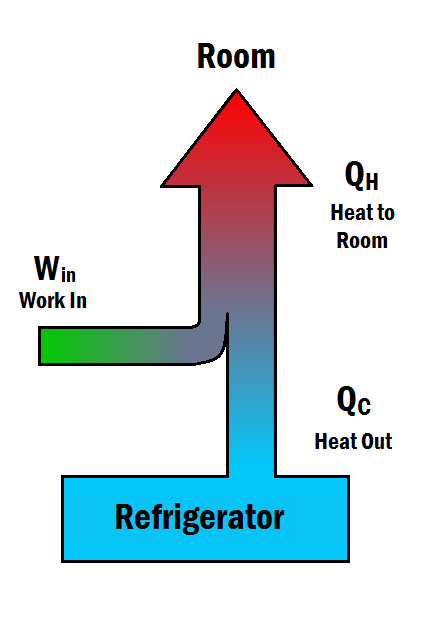
Refrigerator - Energy Education

Pin Oleh Sein Lin Di Air Conditioner

Working Principle Of Refrigerator How Does It Work In 2021 Ozone Layer Low Pressure Principles

How-does-a-refrigerator-work

Carnot Cycle Thermodynamics Internal Energy Brayton Cycle

Could Man Make Icebergs By Using A Refrigerator That Freezes Water In The Sea To Ice And Therefore Eventually S Refrigerator Compressor Compressor Refrigerator

How Air-source Heat Pumps Work Heat Pump Heat Pump System Air Heat Pump

Physics - Thermodynamics 11 Of 14 The Refrigerator How It Works - Youtube
Komentar
Posting Komentar